The silver spotted skipper butterfly is our June Pollinator of the Month. It is one of the most recognized butterflies in North America. While it can be found throughout the continent, it is most common from the Great Plains eastward. According to data on iNaturalist, the silver spotted skipper is found in every US state except Alaska and Hawaii. To me, it is easily my most seen butterfly when hiking or botanizing, though my records on iNat do not confirm this. That is because I have not recorded every finding of it like I should. And I would guess that is why it is not the most seen butterfly in iNaturalist, but in the top 10 in most states.
But what are skipper butterflies? There are different classes of butterflies, including spreadwing skippers, grass skippers, swallowtails, sulphurs, brush-footed, and more. The silver spotted skipper belongs to the Spreadwing Skippers, which hold their wings open or partially open when at rest. This class also makes rolled-leaf shelters for its larvae, can converge at puddles, and gather nectar from flowers. They are called skippers because their flight paths contain jerky "skipping" motions.
Why So Many Skippers?
The silver spotted skipper is most commonly seen for 2 reasons. First, it is relatively large for a skipper butterfly, with a wingspan of up to 2.5 inches. And second, it has a large selection of host plants available. While many butterflies are host specific, feeding on only a species or genera of plants, the silver spotted skipper feeds on a family of plants, those in the Legume Family, Fabaceae.
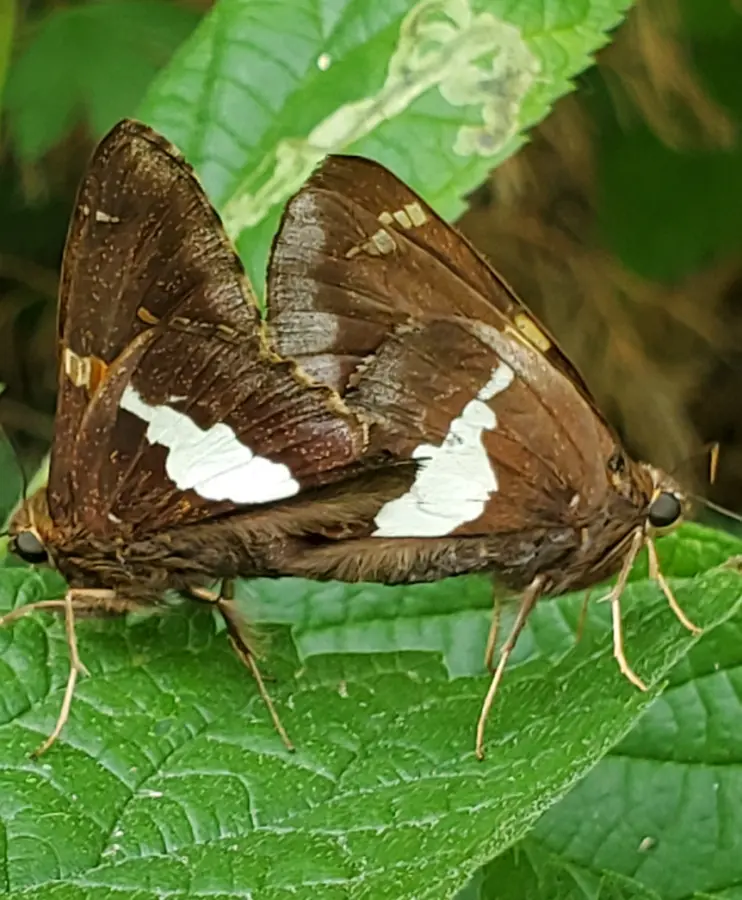
Also, they are showy, with a large white patch on underside of the hindwing, which is where their name comes from. Their eyes seem to bulge out from their heads, and they rest upside-down on grasses and stems when not out foraging. In my own gardens, and out where I hike, they feed on all sorts of nectar producing flowers. Almost anything could be their plant of choice.
They overwinter in leaf litter as a pupal case, rolled up in the last leaf nest they made. The adults emerge in the spring, about the same time as their host plants start growing, which is usually in April. There can be 2 to 3 generations of adults in our region.
Life Cycle
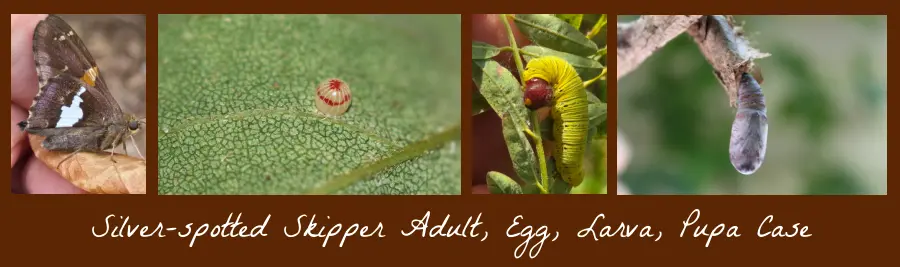
The silver spotted skipper is like other butterflies who undergo complete metamorphosis. This is a four-stage development process (egg, larva, pupa, adult) where the larva is quite different from the adult insect.
Eggs are laid singly on the upper side of host plant leaves. After hatching, the caterpillar feeds in shelters they make of a folded and tied leaf and silk. They feed primarily at night. After they reach maturity, they form a pupal case on the plant or in leaf litter.
They stay as a pupa for 10 to 14 days in the summer, then emerge as a butterfly. Silver spotted skippers can have 1 to 3 generations per year, depending on food sources and location. Late generations overwinter in the pupa in leaf litter.
Host Plants
While many other butterflies are choosy, the silver spotted skipper is picking on nearly every kind of plant in the Legume Family. With more than 1700 species of plants in the United States, there can be a lot to choose from. This is why the silver spotted skipper is not threatened nor endangered. It has a huge host plant catalog to choose from.
In our region alone, there are as many as 160 species of legumes for it to choose from. And while it seems to prefer natives, it also feeds in introduced species of plants such as soybeans, alfalfa, sweetclover, hairy vetch, and Chinese wisteria.
As for its native hosts, I could list a lot. But the following are one which I have personally found as hosts, and ones which are good for our landscapes and gardens.
- False indigo, Baptisia
- American Groundnut
- False indigo bush, Amorpha fruticosa
- Partridge Pea
- Honeylocust
- Maryland Senna
- Black Locust
- Goat's Rue
- Kentucky Coffeetree
- American Wisteria
- Wild Licorice
- Leadplant
- Redbud
Nectar Plants
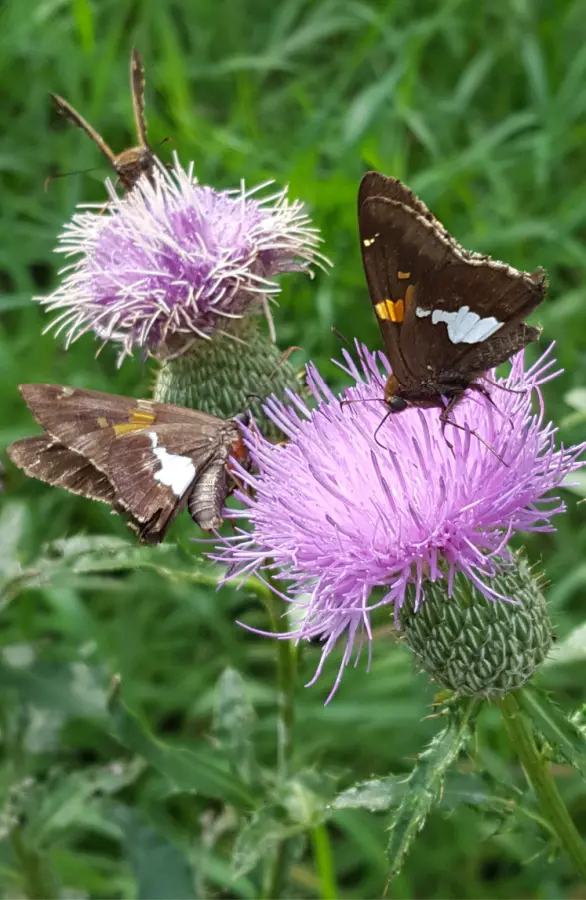
As I mentioned before, the silver spotted skipper lands on just about everything. I have personally seen it gathering nectar on a wide range of plants. I am just going to share some of the better for your garden plants that the silver spotted skipper will visit. In some cases, you may find several of the butterflies on one flower spike.
- Salvia 'May Night', 'Blue By You'
- Ornamental Onion 'Milennium'
- Comfrey
- Dianthus
- Sedum 'Autumn Fire'
- Purple coneflower
- Joe Pye Weed
- Liatris 'Kobold'
- Aster 'Raydon's Favorite'
- Western Ironweed
- Ironweed 'Iron Butterfly'
- Butterfly milkweed
- Honeyvine milkweed
- Agastache 'Blue Fortune'
- Hoary skullcap
- Woolly Verbena
- Seven Son Tree
- Buttonbush
- Purple milkweed
- Betony 'Hummelo'
Conclusion
The silver spotted skipper is one of the most common butterflies in our region as well as throughout the lower 48 states. This common butterfly has a wide range of host plants, and gathers nectar from many different plants as well. When it flies, it appears to be "skipping" through the air.
Happy planting!