Are you looking for an understory tree for a shady spot in your yard? If so, then consider the Japanese maple (Acer palmatum). Despite not being native to North America, these are one of the more iconic landscape trees known. Unfortunately, they do not survive in all parts of the US, but they can be grown successfully in many areas. Here in the Central Great Plains region, we can grow several cultivars of Japanese maple trees.
I learned about these trees long before college, back in high school when I was actively learning plants for my future career. In my hometown of Concordia, KS, I would see Japanese maple trees grown mainly as understory trees in home landscapes. I learned more about them in college and then I learned to prune them while working in Topeka, KS. They are great for a variety of reasons.
History of Japanese Maples In the United States
Japanese maples first made their way to the US in the 1800s via introductions from Europe. They went first to botanical collections and arboretums. But it was after WWII when they first started becoming popular in home gardens. Returning soldiers who had been to Japan brought home an appreciation for Japanese style architecture and gardening. And thus the deluge of Japanese maples began.
With breeding programs across the country and worldwide, Japanese maple trees have become staples across the states. They are widely adaptable, growing in Zones 5 to 9, and they do well as understory trees or on the shaded sides of the house.
Types & Cultivars
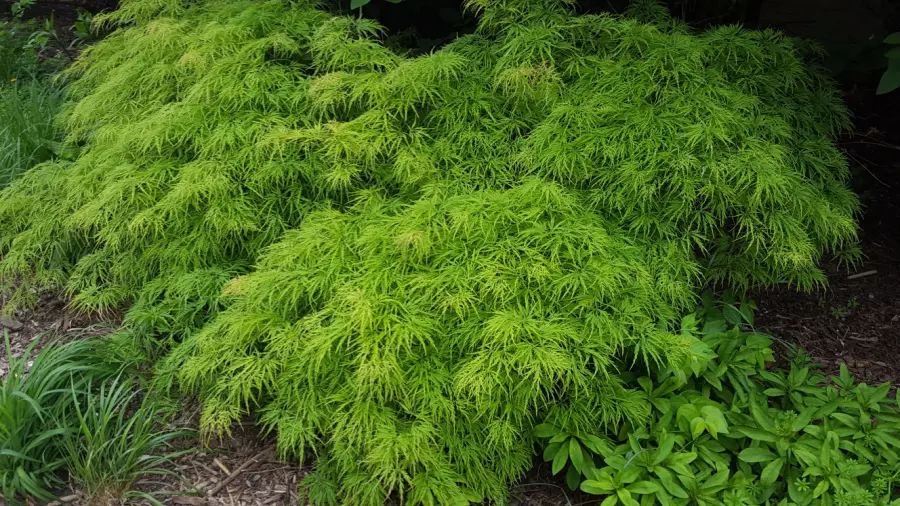
All Japanese maples have a unique look to them. But there are 2 main types to choose from when selecting them for the landscape. Those of waterfall or upright. Waterfall types are weeping or semi-weeping. And upright, well, are upright! Either type can have variegated, green, or reddish/orange leaves during the summer. Most types turn either red or yellow in the fall.
Waterfall Types
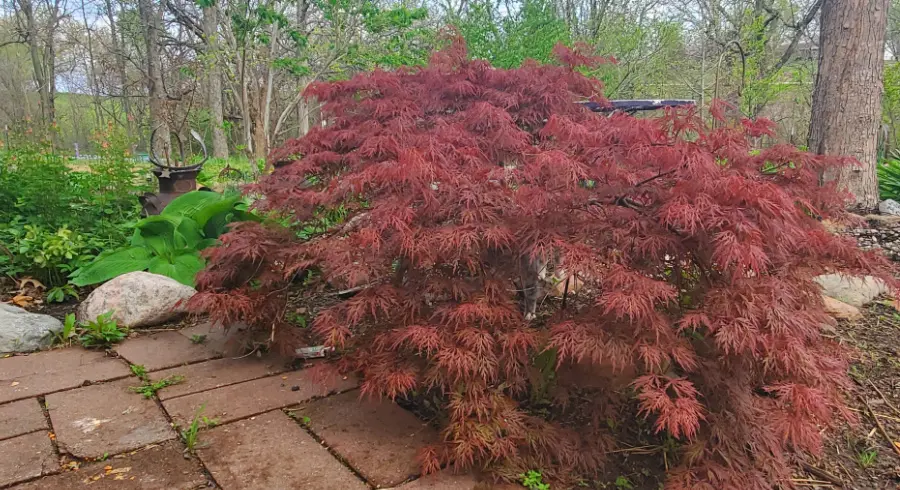
These are not truly weeping trees, but semi-weeping. You can train the habit of them when they are young to have curves and other trunk deformations. They are called waterfall because the branches seem to cascade downward much more like a waterfall with ripples, than like the true weeping form of a weeping mulberry or willow. There are many different color forms and cultivars to choose from, but I recommend you start with a tried and true favorite for your region, and then experiment with some others that may be less proven. Most waterfall varieties grow no bigger than 10 feet tall and wide.
I have met collectors in Topeka and Kansas City who have planted extensive numbers of Japanese maples around their shaded and woodland properties. I would not recommend that unless you have a lot of money to spend on them because they can be pricy. Even smaller sizes often run in the hundreds of dollars. The less common ones are especially pricy. Here are some of the cultivars I recommend for our region.
- Tamukeyama (redleaf)
- Orangeola (redleaf)
- Crimson Queen (redleaf)
- Red Dragon (redleaf)
- Weeping Green (greenleaf)
- Ryusan (greenleaf)
Upright Forms
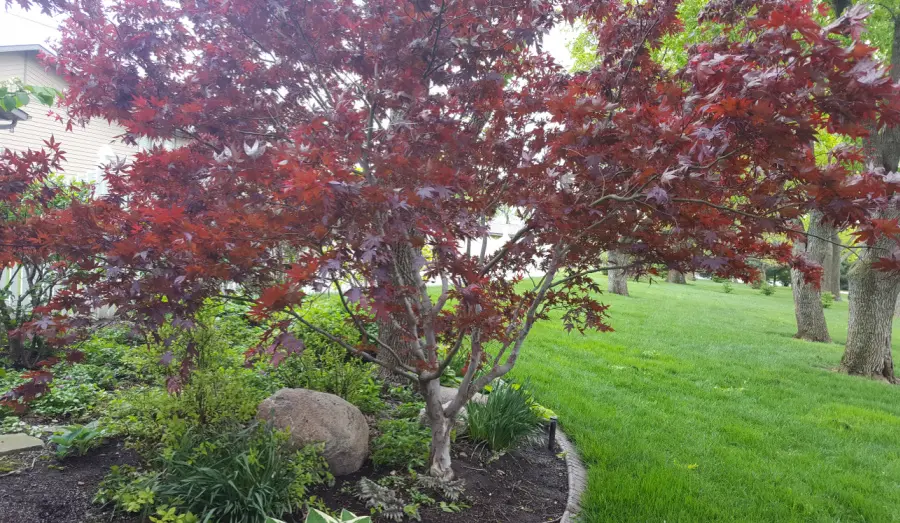
Typically, the more upright forms are not cutleaf, but there are exceptions. They also get bigger. Some varieties in our region can grow 30 feet tall and wide. I have even seen some growing in nearly full sun conditions in Atchison, KS. Upright Japanese maples are more like the maple trees you see in Japanese paintings, but not necessarily in their gardens. The leaves are broader. And they are usually red in color, though green forms are available.
The following is a list of my recommendations for upright Japanese maples for the Central Great Plains region.
- Emperor I (redleaf)
- Bloodgood (redleaf)
- Green (greenleaf)
- Twombly's Red(redleaf)
- Geisha Gone Wild (variegated green/red)
- Purple Ghost (purple/red leaf)
Pruning & Care
If you follow proper planting guidelines for your Japanese maple trees, then you are going to have less problems down the road. Siting for them should be where they get the most protection from late afternoon sun and heat, and winter winds from the northwest. They can be planted as understory trees on the edge of the dripline under larger shade trees. And they are tolerant of oaks and black walnuts.
One planted and established, thy require very little care and maintenance. Japanese maples can suffer from scorch in the hot summer sun, so place them where they get shaded at least from 2 pm onward during the summer months of June, July, and August. Also, they do not do very well with drought, and will start scorching or dropping leaves during a drought. Keep them watered.
Pruning is pretty simple, keep the dead branches inside trimmed out. If you are wanting them shaped, find an expert arborist who has pruned them before. The branches are very brittle and can snap easily if great care is not taken at pruning.
Companion Plants
In our region, it is best to plant Japanese maple trees in the shade, or at least where they are protected from the late afternoon sun and northwestern winter winds. A shade garden is the perfect place for them, either near water or among other plants that compliment them. When I planted my 'Orangeola' originally, was able to twist and turn the main stem so it appeared to weep over at 90 degrees. I then planted it over my water feature at the old house. When we moved, I moved the tree and planted it along the entrance to the porch.
There are a lot of plants, from shrubs to perennials which can complement the look and habit of the Japanese maple. And you can plant them in more sun, as long as they get protected in late afternoon. Look at the following plants to help highlight your Japanese maples.
Shrubs
- Hydrangea 'Annabelle'
- Hydrangea 'Stormproof'
- Oakleaf Hydrangea 'Jetstream'
- Deutzia 'Chardonnay Pearls'
- Yew 'Densiformis'
- Japanese Plum-Yew
- Boxwood 'Independence' 'Liberty Belle' 'Little Missy'
- Doublefile Viburnum 'Mariesii'
- Falsecypress 'Gold Mops'
- Spruce 'Blue Globe'
- Virginia sweetspire
Perennials
- Hostas (any) but I really like larger leaved varieties like 'Gigantosaurus', 'Humpback Whale', 'Krossa Regal'
- Aralia 'Sun King'
- Bleeding heart
- Coral Bells
- Japanese painted fern
- Autumn fern
- Woodland blue phlox
Groundcovers
- Ajuga
- Beesia
- Lilyturf
- Deadnettle 'Purple Dragon'
- Plumbago
Conclusion
Japanese maple trees can lend a sense of Japanese style to a landscape, or just be used as a focal point within the garden to attract your eyes and move your through the garden. They have different forms and can be trained and pruned in various ways. Adding them to the garden can provide color, texture, and form. Add some to your garden today if you do not already have one.
Happy planting!