About Buttonbush
Buttonbush, Cephalanthus occidentalis, is our August plant of the month for 2025. Common throughout the Central Great Plains Region, buttonbush grows east of the high plains of the Great Plains to the Atlantic Coast. It can be found growing wild alongside lakes, rivers, and wetlands, with its feet partly in the water. But it is very drought tolerant, and will grow in many different parts of the landscape.
Buttonbush can grow 4 to 15 feet tall and wide, but newer cultivars have limited size.
- ‘Sugar Shack’ is a Proven Winners variety which grows 4 to 5 feet tall and wide.
- ‘Fiber Optics’ is the First Editions cultivar from Bailey Nursery, which grows 5 to 6 feet tall and wide.
Landscape Uses
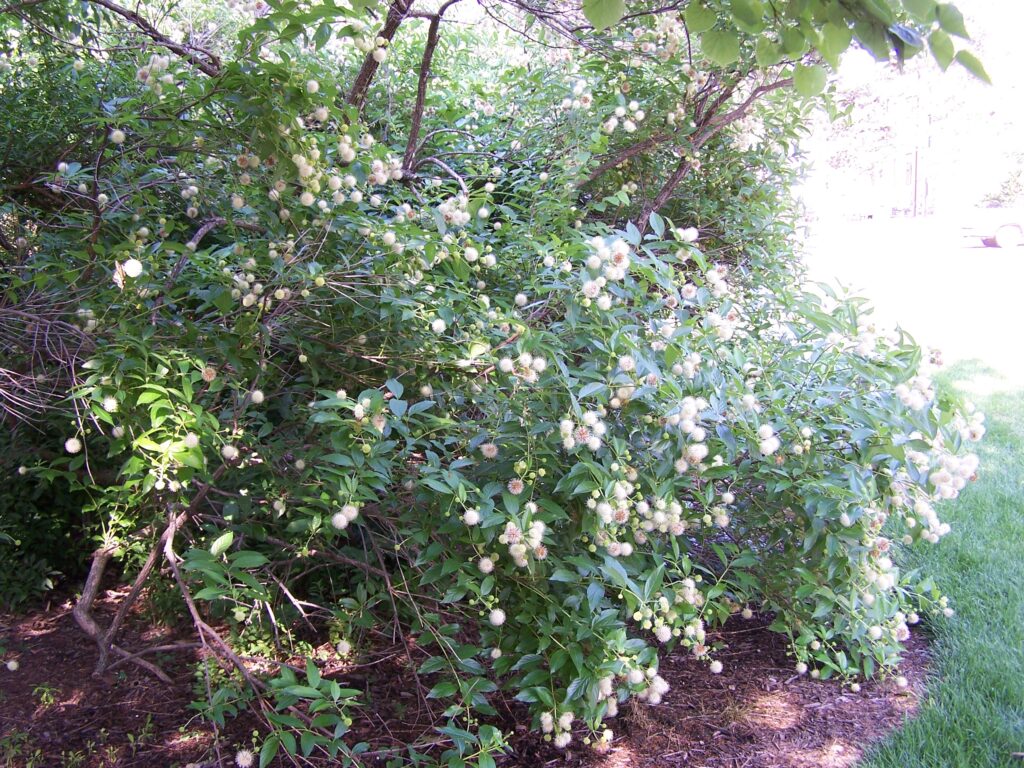
One of the things most people do not know of buttonbush is that it is one of the last plants to leaf out and grow in the spring. Even when the hibiscus, the Rose of Sharon, and the walnut are leafed out, the buttonbush is still last. But that does not mean that it will not make up for lost time. Because it blooms on new growth, you can cut it down hard each spring to keep the height in check. The leaves are shiny and around 6 inches long.
Buttonbush flowers are around the size of a ping pong ball, white, and looks much like a fiber optics ball. You can plant buttonbush in a rain garden, wet meadow, shrub border, or even in a Monarch Waystation. At the Brown County Courthouse in Hiawatha, KS, they have it planted along the sidewalk entrance, and keep it sheared as a hedge.
In late summer, after the flowers fade, the seedheads start as a bright red ball, then fade to dark brown. Fall leaf color is usually yellow to brown, not super showy. But as a landscape plant they are great in the summer months with their shiny leaves and showy flowers.
Insect and Animal Associations of Buttonbush
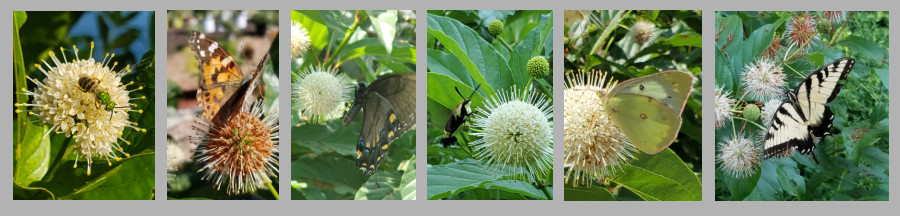
When in flower, they are not only showy, but visited by a lot of pollinators. Large butterflies, such as the eastern tiger swallowtail, Monarch, and giant swallowtail butterfly are frequent visitors. With both nectar and pollen available, other insects also come, including honeybees, bumblebees, cuckoo bees, long-horned bees, leafcutter bees, sweat bees, wasps, thick-headed flies, Syrphid flies, skippers, and other butterflies. Hummingbirds will also visit the flowers.
While the number of insects feeding on the buttonbush is not large, there are 2 beetles, a midge, a plant bug, a sawfly, an aphid, and at least 2 moths which feed on various parts of the plant. In winter, the seeds are eaten by 10 species of duck, the Virginia Rail, and the Greater Prairie Chicken. And some birds will use it as a nest site. The leaves and stems are poisonous, so deer and other mammals rarely feed on it.
Companion Plants of Buttonbush
Depending on which type of garden you are placing it into, there may be several different companions for buttonbush. Try to place them alongside plants which prefer the same soil and water types of the buttonbush, as long as the site matches.
For wetter spots (wet meadows, rain garden, pond edges)
- Joe Pye Weed
- Indigo Amorpha
- Marsh milkweed
- Elderberry
- Cardinal flower
- Rushes
- Cattail
- Helenium autumnale
- Hardy Hibiscus
- Culver’s Root
For drier spots (Monarch Waystation, Shrub borders)
- Common milkweed
- Ironweed
- Woolly verbena
- Baptisia
- Goldenrods
- Serviceberry
- Chokeberry
- Diervilla
- St. Johnswort
- Hazelnut
- Dogwood
- Viburnums
Conclusion
Buttonbush is the plant of the month because it is versatile in the landscape, has few pest problems, is deer and rabbit proof, and attracts a wide range of pollinators. It can be sheared into a hedge, or left to grow on its own. Buttonbush is a reliable bloomer and has interesting seed structures, and decent fall color. If you do not have it, add it to your gardens today.
Happy planting!