I knew about the Kansas Champion Tree Program before I came to Grimm's Gardens, because I was blessed to have a professor of Arboriculture at Kansas State who loved trees. When we went around the grounds of the university to see tree problems, she would point out and show us the champion trees on site.
Once I got to Grimm's, I realized just how cool the champion tree program is, because Doug Grimm is an avid tree finder and he still does some measuring for the Kansas Forest Service.

What Makes it a Champion?
A champion tree is considered the largest, and sometimes the oldest tree of its kind within a state. The program is nationwide, though some states do not actively participate in it. There is also a National Champion Tree program, which recognizes the largest tree of its kind within the country.
Some states, such as Nebraska, only recognize certain trees, such as those which are native or which can reseed on its own and not be grafted. But they usually have exceptions to those rules.
Measurement rules are standardized, or there would be some discrepancy in the national champions.
Measuring a Tree
To measure a tree to see if it is a champion, you will need 3 measurements.
- Height, which can be determined in various ways. A clinometer, or a laser/hypsometer can be used to measure height. I usually estimate height when nominating, basing my numbers off of the heights of building nearby.
- Circumference in inches. This can be measured with a tape at 4.5 feet from the ground. For multi-stemmed trees, measure the smallest stem below the split, if the split is below 4.5 feet.
- Average crown spread is measured by feet. I like to measure under the tree, from dripline to dripline, north to south, then east to west. Add the two numbers and divide by 2.
Points
Points are determined as follows: Height in feet + Circumference in inches + .25 x Average Crown Spread = Total number of points.
For example, if you have a red oak that is 84 feet tall + 108 inches circumference + (78 x .25) = 211.5 points.
The specimen with the highest number of points becomes the champion, either state or national or both for that species.
To be a co-champion, trees must be within 3% of each other in total points.
Looking for Champions
Here at Grimm's, Doug and I both seek out champion trees. When we come across a tree which we think is a champion, we measure it, and then nominate through the Kansas Forest Service or the Nebraska forest service. The Kansas champion tree program has an online database with the nominator name listed. Nebraska has a database, but does not have the nominator listed.
Doug's Trees
Doug has made a reputation for discovering Champion trees, and he even spoke about it at the Iowa Shade Tree Short Course several years ago. Below is a list of Doug's finds and where they are located:
- Quaking Aspen, Topeka
- Northern Catalpa, Holton
- Honeylocust, Wathena
- Norway Maple, Hiawatha
- Red Maple, Wathena
- Dwarf Chinkapin Oak, Morrill
- Eastern White Pine, Robinson
- Black Willow, Morrill
My Trees
Unfortunately, I do not currently have any champions in the Kansas database, though I have nominated several. One of my finds was a Northern Catalpa which beat Doug's tree by several points, but was removed by the owner before it was measured. Another tree is waiting to be measured and put on the list; in 2025 I discovered a lone American chestnut outside of Atchison, which will be the state champion if the homeowner does not remove it.
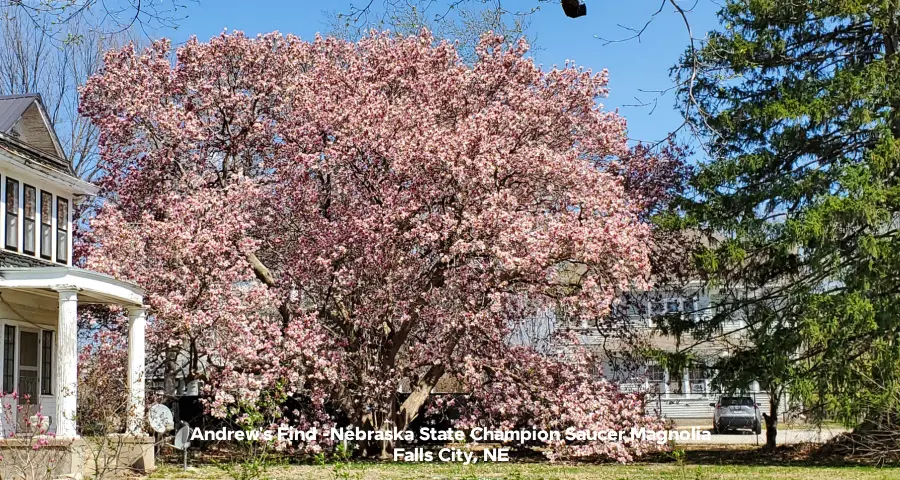
I do have 2 champions in Nebraska though, an Amur maple in Johnson, and a Saucer magnolia in Falls City.
I have also discovered a Green Ash which is quite a bit bigger than the current champion, but did not nominate it because its location made it probable for removal soon.
Champions Worth Seeing
If you are one of those "crazy tree people" who would drive out of the way to see a champion or large tree, take note of the following trees. I have seen these and they are worth taking a look at. Note: Some of these are just cool trees, not big enough to be champions.
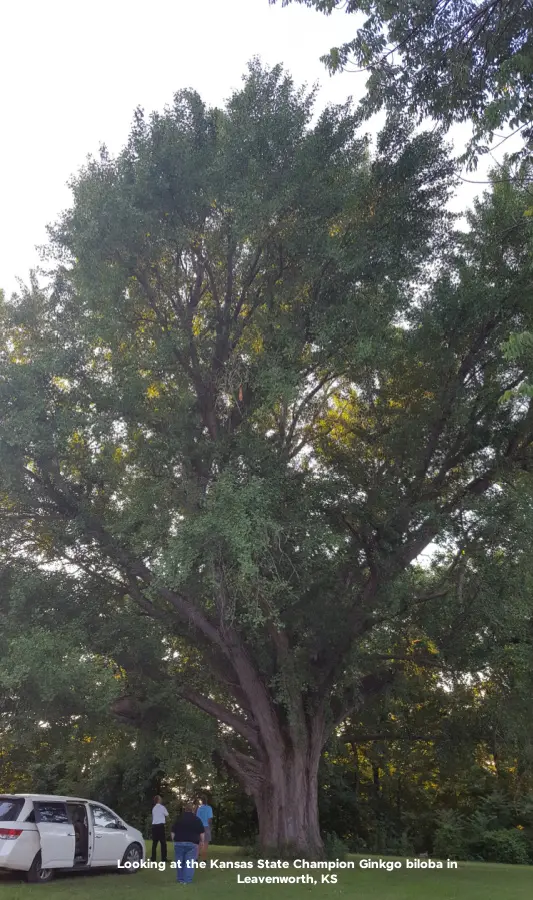
- Ginkgo, Kansas State Champion, Leavenworth
- Northern Catalpa, Kansas State Champion, Holton
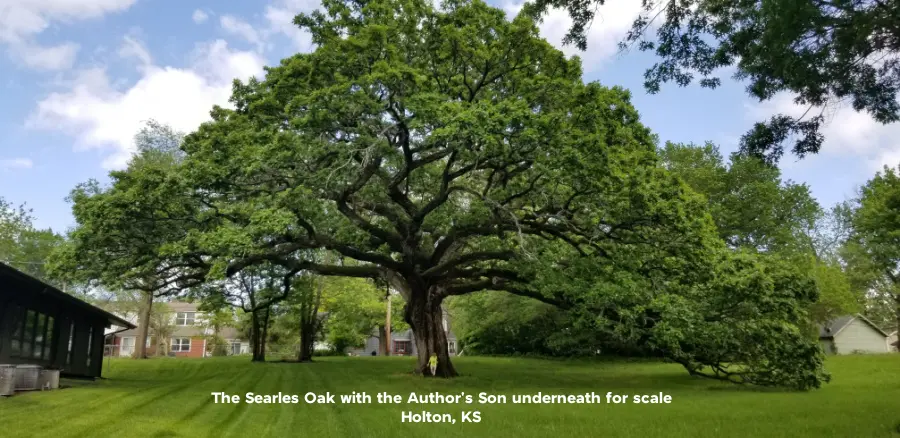
- Searles Oak, Holton
- Eastern Cottonwood, Kansas State Champion, Studley
- Dwarf Chinkapin Oak, Kansas State Champion, Morrill
- Shingle Oak, Kansas State Champion, Overland Park
- Sycamores, Sycamore Springs Whitetails, Morrill
- Hackberry, Brown County Courthouse, Hiawatha
Conclusion
Finding champion trees can be a fun and rewarding time for tree lovers. And for everyone else, it can be a journey which leads into the knowledge and care and love for trees.
Happy Planting!