Now is the time for spring cleanup. Winter is staring to fade away and I know you all want to get out in the garden. By the end of February, I am just itching to get the crews out the door and into the gardens. We usually have around 90 spring cleanup jobs to do for maintenance customers. And they can take a full 2 months to get done. The reason it takes so long to get spring cleanup done is the weather. We usually have a lot of wind in March and April, plus rain, thunderstorms, and snow.
There is a school of thinking (mainly native purists) who think you cannot cleanup your garden in March or April without disrupting major insect and pollinator overwintering. But after many years of watching my own garden, I would have to disagree. I usually do my own spring cleanup in February, around when I start tapping maple trees for sap.
Worried About Pollinators?
For those of you who are worried about insects and pollinators when doing your spring cleanup, I have some solutions for you. Most insects overwinter in leaves and stems. Now, the trick is to move these to another place on the property, where they can still get out. I have several locations around my property where I can put down these stems and leaves. If I do not move them, they will get burned when I burn the grass.
Now, if you are beds are mulched with leaves/straw/fine mulches, then you do not need to remove most of the leaves, just the excess. Nature itself does some cleaning, with wind/worms/animals. If you go out into the forest, especially oak forests, there is a deep layer of leaves, which only a few perennials can break through in early spring. But most gardeners have more than just native ephemerals.
I have 3 to 5 brush piles around the edges of my property, usually out of sight, in which I put stems of the plants I cut down. I do not move leaves in general, unless they were matted down by snow. These brush piles receive cut flower stems, branches, and green clippings (summer). This way, I provide a place for overwintering insects to escape from, and a place for summer birds and wildlife to live. And since transforming my yard this way 10 years ago, I have only see an increase in wildlife.
My Wildlife Numbers
Now, I have to take into account the fact that I am more observant than I used to be. Still, numbers have increased. I checked my wildlife numbers from 2019, when I was starting to be very observant of the life in my gardens. 2019 numbers versus 2025 numbers of LIFE, not counting plants, fungi, lichens, or slime molds.
- Bees 13 - 26
- Butterflies including skippers 27 - 38
- Flies 27 - 59
- Moths 51 - 331
- Dragonflies 4 - 15
- Spiders 15 - 67
- Beetles 40 - 140
- Bugs 21 - 80
- Wasps 15 - 32
- Birds 1 - 33
- Amphibians 4 - 2
- Reptiles 3 - 3
- Mammals 1 - 10
- Mollusks (snails, etc.) 3 - 4
- Grasshoppers, katydids, crickets 6 - 22
- Mantids 2 - 2
- Ants 1 - 4
- Cicadas 1 - 3
- Millipedes, Centipedes 0 - 3
- Mantidflies 0 -1
The numbers keep growing! Each season I add new additions to the list of life happening around me.
What to Cut Back
Now that we got through whether or not you should be cutting stuff back, we can talk about what to cut back. It is important to remember which plants bloom on new wood or old wood. Perennials are nearly always blooming on new growth, so there is not problem there. But it is important to cut hollow-stemmed perennials one of two ways - either close to the ground or about 18 inches from the ground. Both of these methods will ensure survivability for overwintering insects. Hollow-stemmed perennials include:
- Joe Pye weed
- Cup plant
- Swamp milkweed
- Baptisia
- Rattlesnake master
- Bee balm
Shrubs Which Bloom on Old Growth
When doing your spring cleanup, remember that these shrubs bloom on last year's growth, and should not be cut down until after spring flowering. If you are planning to rejuvenate them (cut to the ground for new growth), then you can either cut them down in the spring, after flowering, or late fall.
- Lilacs
- Forsythia
- Viburnums
- Chokeberry
- Azalea
- Oakleaf Hydrangea
- Climbing rose
- Mockorange
- Spicebush
- Chokecherry
- Bridal veil spirea
- Vanhoutte spirea
- Flowering quince
- Deutzia
- Fothergilla
- Sweetspire
- Beautybush
- Pearlbush
- Weigela
Shrubs Which Bloom on New Growth
The following shrubs can be pruned in the spring during cleanup. These shrubs bloom on new growth, and in many cases can be pruned nearly to the ground. You can leave them if you want, but they will bloom better if cut all back fairly hard.
Shrubs Needing Special Pruning
While these could be cut down low to the ground, it would force the plant to grow at a rapid pace, causing twisted growth and loss of habit. It is best to prune these to maintain shape and habit, while promoting flowering.
- Panicle hydrangeas (Limelight, Vanilla Strawberry, Quickfire)
- Rose of Sharon
- Butterfly bush
- Blue mist spirea
- Shrub roses
- Smokebush
- Mountain hydrangea
- Diervilla
- Leadplant
- Bottlebrush buckeye
- Buttonbush
- Ninebark
- Potentilla
- Sumac
- Carpet or Drift Roses
- Tiger Eyes Sumac

Shrubs Which Can Be Pruned Hard in Spring
These shrubs can be cut down to 4 inches tall if desired, or you can cut them at whatever height your feel like.
- False indigo (Amorpha fruitcosa)
- Barberry
- Beautyberry
- Dogwood
- Smooth hydrangea (Flowerfull, Annabelle, Invincibelle series)
- St. Johnswort
- Honeysuckle bushes
- Ninebark
- Smooth Sumac
- Elderberry
- Japanese spirea (Magic Carpet, Candy Corn, Goldmound)
- False spirea (Sorbarius)
- Coralberry or Snowberry
- Chastetree
Grasses
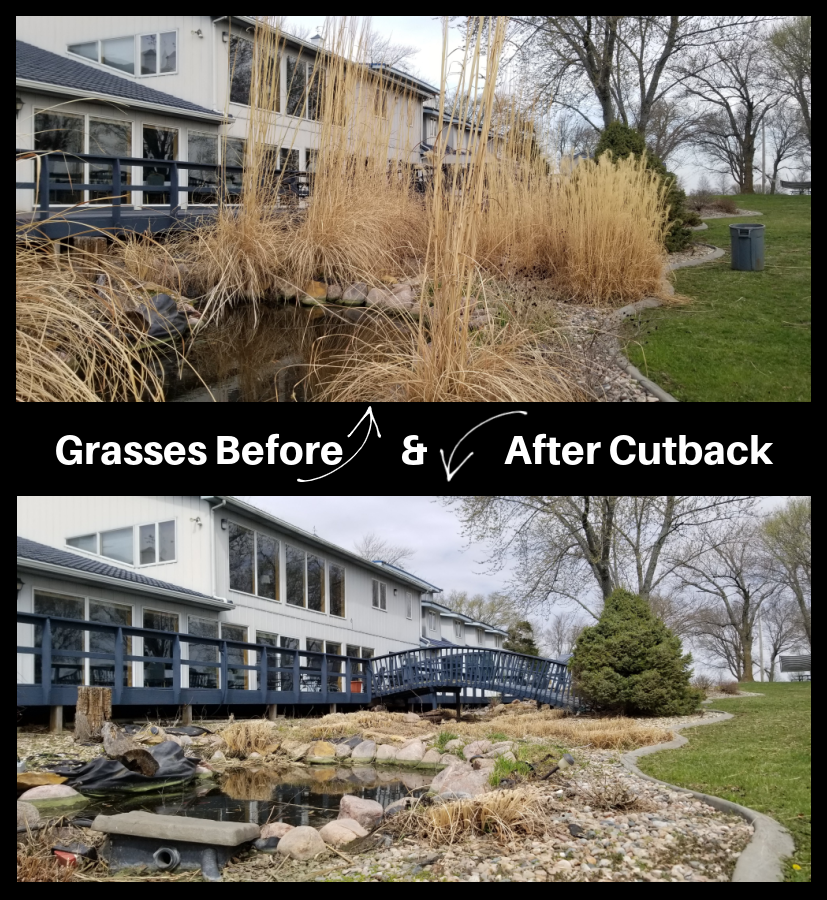
If you have not already done so, then during spring cleanup is time to cut back grasses. Bigger grasses, such as big bluestem, switchgrass, hardy pampas grass, miscanthus, and Indiangrass can be cut back to 8 inches to 12 inches tall. I like to cut smaller sized grasses down to around 4 to 6 inches tall. These include:
- Prairie dropseed
- Blue oat grass
- Pink muhly grass
- Blue grama
- Sideoats grama
- Sea oats
- Feather reed grass
- Pennisetum
- Japanese forest grass
- Little bluestem
- Sedges
Tools of the Trade
When it comes to cutting perennials, shrubs, and grasses back during spring cleanup. everybody has their own tricks and ideas. Since the start of Pinterest, there have been tons of ideas on how to do cleanups. But prefer to use a set of tools which are made for the use, and which can be re-used each time with success. Therefore I promote tools from Milwaukee, Felco, and Stihl. These are the tools we use for spring cleanup.
- Milwaukee M18 Hedge trimmers
- Milwaukee M12 Brushless Pruning Shears
- Felco #11 Pruners
- Felco #2 Pruners
- Stihl Blowers (gas blowers are more powerful and last longer than batter-operated)
- Silky curved blade pruning saw
- Milwaukee M12 Hatchet 6"
- 55 gallon barrel
Conclusion
Spring cleanup should not be dreaded nor put off to another season. There is a real need to get it done while the temperatures are cool outside. Before insects start waking up, you can get the garden tidied up, and still allow for pollinators and insects to thrive.
Happy planting!