Rattlesnake master is our 2025 June Plant of the Month. This is one of my favorite native perennials, and for many reasons. The first time I came across this species was in the native plant garden at Kansas State University, while I was going to college there. I spent many hours in that garden, watching insects and enjoying nature in the city. And rattlesnake master (Eryngium yuccafolium), became one of my favorites.
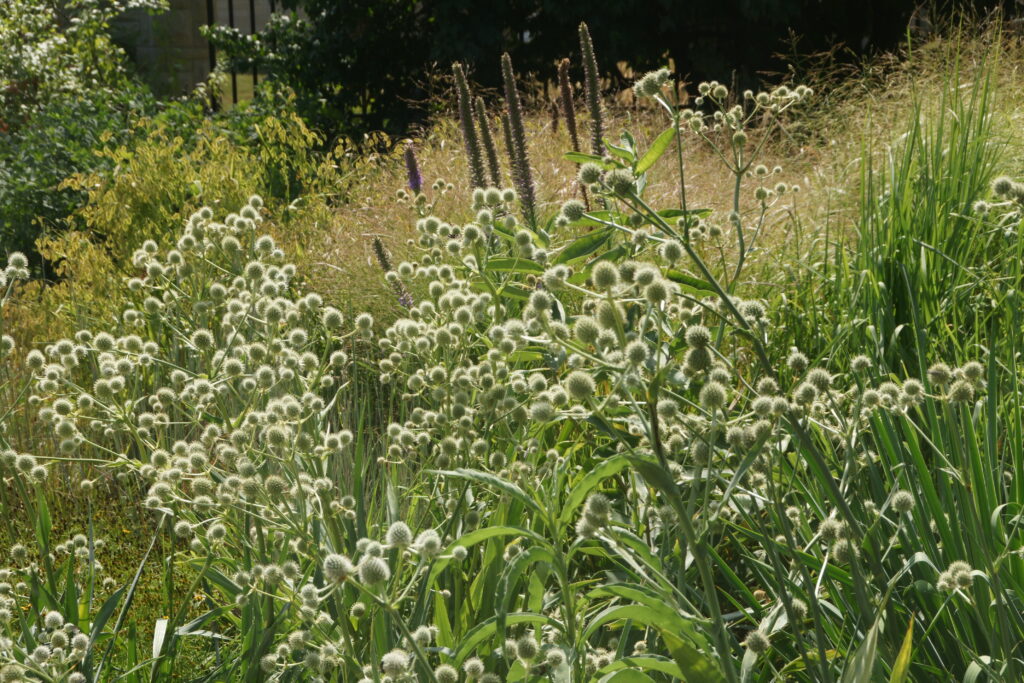
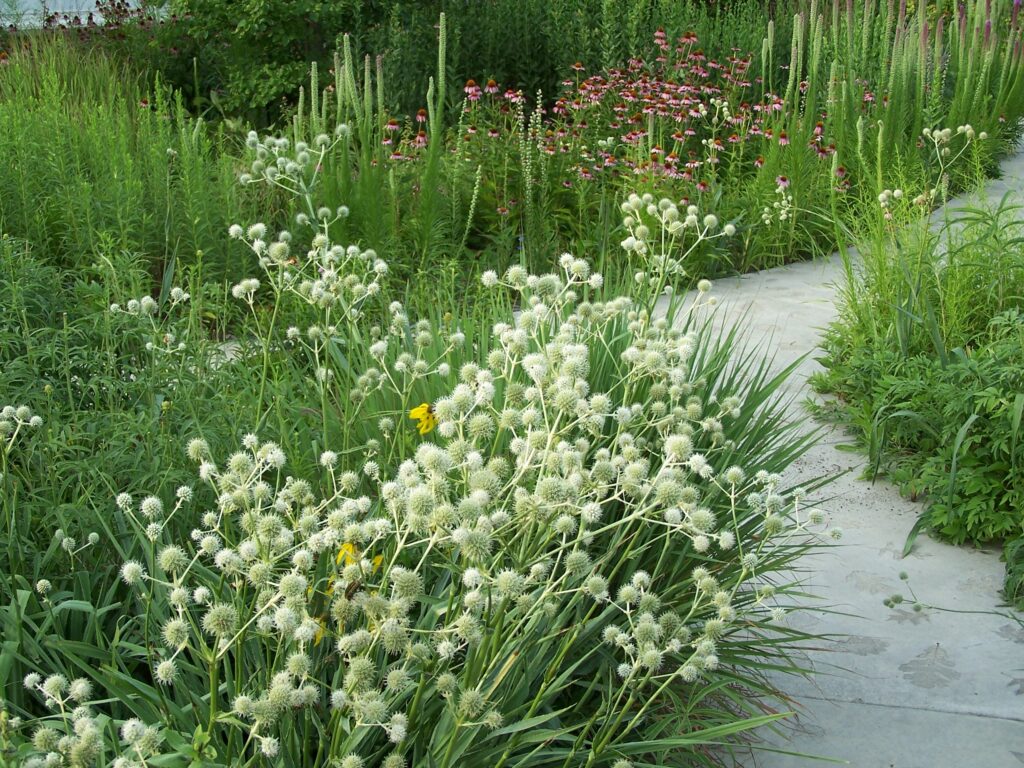
One of two native to the Central Great Plains species of Eryngium, and one of 30 North American Species, rattlesnake master has very architectural structure. The flowering stems rise from yucca-like, gray-green leaves, forming branches before opening with pineapple-shaped, white blossoms. The flowers themselves are enough to grow them for. It grows 3 to 5 feet tall and wide, in a clump.
Uses For Rattlesnake Master
The name rattlesnake master comes from Native American folklore, where it was used extensively. A poultice was made from the roots of the plant and applied to snakebite wounds as a treatment, while the sap was used as a preventative from the venom. Besides treating snakebites, different parts of the plant were used for the following ailments:
- Fevers
- Urinary tract infections
- Kidney stones
- Skin disorders
- Shortness of breath
It is also a great cut flower, either fresh or dried. My mother-in-law has used it in arrangements at her church in northeast Kansas. Besides all that, rattlesnake master is an excellent native plant for pollinators.
Where to Plant
It should be planted in any garden where native plants are used. However, you can also plant it singly or in masses by itself. The meadow garden, butterfly garden, or Monarch Waystation are all typical spots for it to go. It prefers full sun, and well-drained soil. But it can thrive in areas where rain comes through (such as in a ditch or rain garden) but does not stay.
As A Pollinator Plant
Rattlesnake master is a very good plant for pollinators, providing both nectar and pollen. It is a member of the Parsley or Carrot Family, which has umbel shaped flowerheads. Rattlesnake master flowers are bunched together into a ball, but can contain as many as 106 individual flowers in each ball. There are many different types of pollinators which visit the flowers. The following is a short list of some of those pollinators:
- Butterflies including monarchs, swallowtails, and skippers
- Longhorn beetles
- Wedge Beetles
- Soldier flies
- Bumblebees
- Carrot wasps
- Social wasps
- Mason and Potter wasps
- Beetle hunting wasps
Host Plant Status
This plant does not provide much for insects feeding on it, but it does play host to the wavy-lined emerald moth which feeds on flower parts, the Eryngium stem borer moth, and a flower-feeding moth. Also, the stems, which are hollow, are utilized by native bee species.
Companion Plants
Being a great plant for the meadow or pollinator garden gives it a special place alongside other plants with similar natures. It blooms primarily from June to August, so plant it with complimentary plants that are either blooming at the same time, or in succession with it. Try any of the following plants alongside:
- Prairie blazing star, Liatris pyncnostachya
- Switchgrass
- Northern sea oats
- Purple coneflower, Echinacea purpurea
- Greyhead coneflower, Ratibida pinnata
- Pale purple coneflower, Echinacea pallida
- Ozark coneflower, Echinacea paradoxa
- Agastache ‘Blue Fortune’
- False sunflower, Heliopsis helianthoides
- Showy Milkweed, Asclepias speciosa
- Prairie dock, Silphium terabinthenaceum
- Stiff Goldenrod, Solidago rigida
Conclusion
As our 2025 June Plant of the Month, Rattlesnake Master fits the bill as a great plant for pollinators, a good cut flower, and an interesting species in the garden. Add it to your garden today for a first-season impact.
Happy planting!’