Poison ivy is the bane of nearly every gardener from the Rocky Mountains to the Atlantic Coast. And those living east of the Missouri River have a triple chance of infection with poison sumac and poison oak also being a possibility. Here in the Central Great Plains region, we have just poison ivy, either eastern or western. This native vine/shrub/groundcover vine has a nasty reputation among gardeners.
Before I moved to Manhattan to study Horticulture at Kansas State University, I was not allergic to poison ivy. Neither my Dad nor I were. But a few months after I moved to Manhattan, I went to do a job for the landscape company I worked for, surveying a ravine for landscaping, and I had my first allergic reaction. So I know how everyone feels about it.
What Makes it So Bad?
The reason for our allergic reactions to this vine is the oil sap, urushiol. This compound acts as a small molecule that binds to skin proteins, altering their shape and triggering the severe, delayed-type IV hypersensitivity immune response. The altered skin cells are identified by the immune system as foreign invaders, causing inflammation, redness, heat, and blisters.
Roughly 15-25% of the population has no allergic reaction to poison ivy because their immune system does not recognize urushiol as a foreign invader. I have a theory to go along with that, though there is no evidence backing me up. Before I moved to Manhattan for college, I lived in the country, and had a different lifestyle. I drank a lot of raw milk, ate mostly healthy foods, and stayed outside most of the time. When I moved to Manhattan, I began eating out more, staying inside more often, and was exposed to more pressures on my immune system. I think my immune system was compromised when I moved and met up with poison ivy.
You can also build up a sensitivity by increased exposure to urushiol. In other words, the more often you touch or encounter it, the more likely you will be to have a reaction. There are some who believe that exposure in very small quantities can actually cause immunity to urushiol, but there is little evidence to support that.
What Does Poison Ivy Look Like?
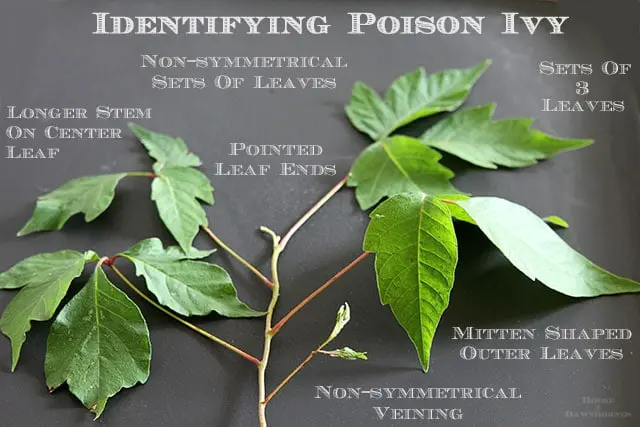
Both the eastern and western varieties can be found throughout Kansas and the Central great Plains Region, though western poison ivy is not considered to be found in Missouri. These plants can be vines on the ground or climbing, or form small shrubs. And while there is some variation in this, leaves are typically in clusters of 3 leaflets per stem. The petiole of the central leaf is slightly longer than the other two leaves (leaflets). The leaf (made up of 3 leaflets) comes singly off the vine.
Unfortunately, the leaflets themselves can have edges which are smooth, wavy, or toothed. Early spring growth is reddish-green and they turn all green by summer. Fall color is an excellent shade of red, which is one of the reasons plants were collected for botanical collections in Europe and Asia. The flowers are insignificant, green with a yellow center, and borne in panicles. After the flowers fade, white-green berries form in place of the flowers. The berries are consumed by birds and some mammals.
What About Other Types?
Poison sumac, Toxicodendron vernix, is not found in our region. It grows primarily in the Upper Midwest (Wisconsin, Indiana, Ohio, New York) and along the Atlantic Coast and Gulf of America Coast. It grows in swampy habitat and can be distinguished from non-poisonous sumacs by its smooth, glossy leaflets and white berries.
Poison oak, Toxicodendron pubescens, can be found in the extreme southeast corner of Kansas, and 12 counties in Missouri, primarily along the southern border. It also has the "leaves of three" id note, but the leaves look more like oak leaves, and it grows more often as a shrub rather than a vine. It can found primarily in southern states, from Maryland to Texas.
Winter
In the winter, poison ivy vines, at least on trees, have a stringy or hairy appearance, with all the roots that are coming off. There may be berries hanging on. While many would assume that you are safe in winter, the vines also carry urushiol, and an infection is just as likely. My worst ever infection came from pruning the vines off a wall in winter.
Protection While Gardening (or other work)
Allergic reactions to poison ivy come when are in contact with it on your skin, or through infected clothing, tools, or pets. Once you learn how identify it, you can take more precautions for avoiding it in the landscape. When gardening, what do you like to wear? If you have had problems in the past, or go to multiple sites for work outside, then I would suggest the following things to wear:
- Long pants, not shorts or skirts
- Socks
- Shoes or boots (no flip flops or crocs)
- Long-sleeved shirts are optional, as long as you can keep your arms clear.
- Gloves if weeding or pruning
Treatment After Contact
If you know that you have contacted or suspect you have come in contact with poison ivy, there are some steps you can take before the rash develops. You can usually wash off the urushiol if you get to soap and water within 10 minutes of contact. After that time, you have little chance. I like to keep a strong soap in my truck for when I am out working. If I suspect I touched a leaf or stem, I rush to the closest water source, usually a hydrant, and wash vigorously for several minutes, with soap.
I have found that after that initial 10 minute time, no amount of scrubbing or use of an over-the-counter scrub will remove the oils from my skin. But you may have a different story, after all, everyone's reaction is different.
Once you have been exposed, and a reaction sets in place, there are treatment options. YOU CANNOT SPREAD A REACTION FROM YOUR SKIN TO SOMEONE ELSE, THOUGH THEY CAN GET IT FROM YOUR CLOTHING OR TOOLS.
I really like to use Ivarest, Poison Ivy Itch Cream when I have a small infection, usually just a few spots or small area. It does wonders. Calamine lotion also works very well for this, as does burn cream. Aloe vera also works, but does not relieve the itching, only the inflammation. Taking an oral antihistamine like Benadryl or Loratadine can relieve the itching too (ALWAYS READ LABELS FOR DOSING).
If you have a severe reaction, such as over multiple spots on your skin, in your eyes or mouth, or in private areas, see a doctor. They may recommend a more concentrated treatment.
Removing it From the Garden
In your garden or landscape, there are options for removing poison ivy. If you just have a few plants or vines, I would suggest getting some heavier disposable gloves and a face mask, then pulling out the plants and disposing them in a trash bag. NEVER BURN POISON IVY as the oils are released through the smoke and can get in your eyes and throat.
For larger areas it may be necessary to use chemicals or bring in a grazing animal. If you have the space to do so, and can, then get some electric fencing and a goat. They will eat the poison ivy to the ground and any re-emerging growth as it comes up. There are also some farmers who rent goats just for clearing land of poison ivy and brush.
If you think you cannot bring in goats and there is too much to pull out, then chemicals are the next best option. I recommend cutting back as much of the growth as possible (again wearing disposable gloves) and removing to a trash bag. Then, wait about a week for new growth, then spray with Triclopyr, a chemical used in stump remover and in association with other chemicals for woody plants. NEVER USE PICLORAM from any chemical source, as it moves in the soil through root grafting or touching and can kill mature trees.
Other Options
Another option for removing or killing poison ivy from the garden is smothering. This is the use of materials to smother or kill the plant. If you have a small area, and pulling is not doing the job, you can lay clear or black plastic over the area, cover with stones or bricks, and let it sit for 3 to 6 months. That should b long enough to smother out annoying bits of poison ivy.
What is Poison Ivy Good For?
Nothing, is what most gardeners would say. But do not forget, it is a native vine. There are some benefits to it. Many birds and animals consume the leaves and berries without getting any type of reaction. The berries are high in fat and provide a high-calorie resource for over 60 types of birds including woodpeckers, warblers, quail, robins, and chickadees when other foods are scarce.
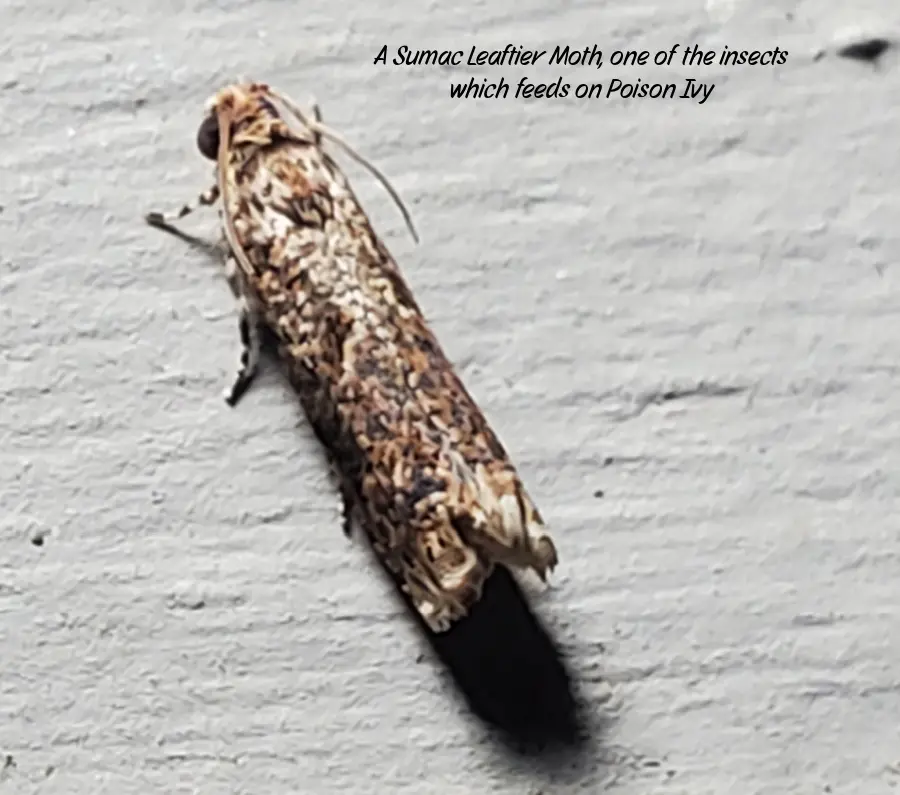
It usually pops up first in disturbed areas, holding the soil in to prevent erosion. Many different pollinators visit the flowers, including hover flies, thick-headed flies, cuckoo bees, small carpenter bees, and masked bees. And it provides food for several native insects including 6 beetles, 5 aphids, 1 gall-making fly, 1 sawfly, 6 leafhoppers, and 8 moths.
Animals such as deer, rabbits, elk, and moose feed on the stems and leaves.
Conclusion
Though poison ivy does have some benefits as a wild plant, in the garden we would rather it be gone. No matter how you deal with it, be careful to not get it on you and potentially have a rash and other problems. There are ways of avoiding and managing poison ivy in the garden. So take care.
Happy planting!