Surprise!
I was totally surprised to discover that the Perennial Plant Association named a grass (Blackhawks big bluestem) as the perennial plant of the year for 2026. Has this happened before? Well, yes it has. Three times before now the PPA has nominated a grass as the perennial of the year. Little bluestem in 2022, Northwind Switchgrass in 2014, and Aureola Japanese forest grass in 2009. Are we trending towards adding more grasses into the perennial mix in the future? There are a lot of outstanding native grasses coming through the market.
If you read last week's post on using native grasses in the landscape, then you can see the advantage of making grasses more popular. I love having my meadow garden full of both grasses and herbaceous perennials and annuals, but its nice to see more moderate landscapes adding more grasses to them. And using Blackhawks big bluestem is a good way to do so.
Origin of Blackhawks Big Bluestem
Where do new plants come from? Well, they can be started in a variety of ways, from plant breeding to selection of an individual with desirable traits, to a sport or seedling of another favorite. The latter is how Blackhawks big bluestem originated. It was developed by Brent Horvath of Intrinsic Perennial Gardens in Illinois from a seedling of another favorite bluestem, Red October.
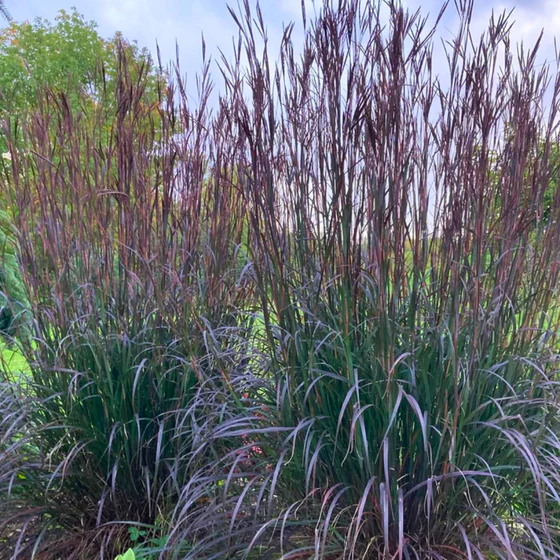
And of course, it was not named for the dark almost black color of the stems and leaves, but for the Chicago Blackhawks, the local hockey team. But does it really matter? We get a great cultivar of one of the best native grasses and only a few know who it is named for. After testing at the Chicago Botanical Garden, it was released to independent growers and garden centers in 2017.
About Big Bluestem
Big bluestem is a clump forming grass, native from the Rockies eastward. It is primarily found in tallgrass prairies from the eastern 1/3 of the Great Plains eastward. It can grow as tall as 8 feet and spread in a clump to 6 feet wide. Big bluestem is the dominant grass of the tallgrass prairie. Because it is a warm-season grass, it does not start getting big until summertime, allowing cool-season grasses to grow and mature before it gets big.
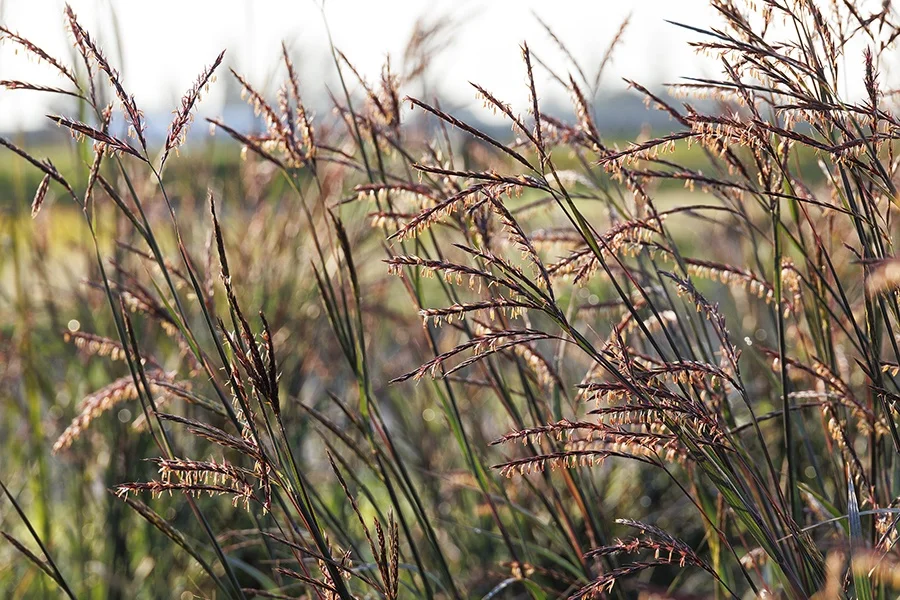
Floral inflorescences begin to grow and come on in midsummer and the flowerheads are often called turkey feet because of their three-toed shape. The seedheads are one of the more distinguishing characteristics used in plant identification. Big bluestem grows in full to part sun and can be drought tolerant once established.
Pests and Problems
The biggest problem with using big bluestem in the landscape is its tendency to flop or fall over. In the typical prairie setting, it will not do this, because it has the root and support structure of other grasses and plants surrounding it. However, selecting for uprightness has led to the cultivars of Blackhawks, Red October, and Rain Dance for use in landscaping.
There are a few insects which feed on big bluestem, but cause only minimal damage including grasshopper, katydids, and leafhoppers. The larva from the Delaware, Cobweb, Ottoe, and Leonard's skippers use the foliage as a host plant, as well as the foliage of other native grasses. Field, chipping, and tree sparrows have been seen eating the seeds. It has no known disease issues in the landscape.
Where to Plant
Because of its size and structure, Blackhawks big bluestem cannot be put into just any spot in the landscape. It could be used as a mass planting, interspersed with early bulbs. Or you could plant it as a backdrop for a perennial bed, with varying heights of perennials and other grasses in front of it. Maybe you would want to use it on either side of a door or window, or on the corner of a house. You could also use it as a screen to block the view of a propane tank, or ac unit, or generator.
Another possibility it to use it in a large planting of native and naturalized plants. If you are creating large sweeping beds of native perennials and grasses around corporate campuses, you may want to plant Blackhawks big bluestem among the other things. Maybe take a page from the ideas of Piet Oudolf.
I personally like to use Blackhawks big bluestem in a small meadow garden among flowers and grasses which complement its height and stature in late summer and into fall. But I have also used big bluestems in smaller native beds, among long blooming perennials such as rudbeckia or ornamental onion.
Companion Plants
Blackhawks big bluestem can be planted among a lot of native and non-native plants. It would fit just as well among shrubs as with perennials and other grasses. For pairings, I recommend separating into categories. Such as meadow style, screening, and perennial borders. I think it would fit well into the tall perennial border I am planning for the northern edge of my orchard.
Planting in Meadow Gardens
Plant the following plants alongside Blackhawks big bluestem in a meadow style garden:
- Cultivars of Baptisia
- Little bluestems
- Switchgrass
- Pink muhly grass
- Prairie dropseed
- Prairie cordgrass
- Common or showy milkweed
- Meadow rue
- Compassplant
- Cup plant
- Pale purple or purple coneflower
- Tall boneset
- Rattlesnake master
- Perennial sunflowers
- Mountain mints
- Woolly verbena
Screening With Blackhawks
Use the following plants along with Blackhawks when creating a screen:
- Arborvitae 'Sting'
- Arborvitae 'North Pole'
- Switchgrass 'Totem Pole'
- Serviceberry 'Standing Ovation'
- Buckthorn 'Fine Line'
- Viburnum 'Blue Muffin'
- Rudbeckia 'American Gold Rush'
- Agastache 'Queen Nectarine'
A Tall Perennial Border
These are the plants that I would place into a tall perennial border along my orchard along with Blackhawks big bluestem:
- Common boneset
- Tall boneset
- New York Ironweed
- Coreopsis tripteris
- New England Aster
- Wingstem
- Rudbeckia laciniata
- Garden Phlox
- Obedient Plant
- Blue Vervain
- Meadow blazingstar
- Jerusalem artichoke
- Rattlesnake master
- Switchgrass
- Meadow Rue
- Culver's Root
Conclusion
Blackhawks big bluestem is an imposing plant, and needs to be used accordingly. I would recommend planning where to put it ever before buying. This is not one you are going to want to impulse buy. Plan for it. It is easy to grow, drought and heat tolerant, and has no insect of disease problems. And the fall color is excellent, turning a bright red as the nights get cooler and cooler. I hope you will like it as much as I do.
Happy planting!