American horticulture certainly started before America's birthday of 1776. But most of the more important events surrounding America's horticulture story happened during the 250 years that our great country has been a nation. We are going to go through some of those events, and see how gardening has been shaped over the past 250 years.
1728 - John Bartram Creates America's First Botanical Garden
What must it have been like for the early founders of America to see the new plants being discovered right and left as explorers went across the land! John Bartram was one of those explorers, bent on discovery. He was a self-taught botanist, a Quaker from Pennsylvania. He started the first botanical garden of the New World, in Philadelphia. Bartram discovered between 150 and 500 American plants, adding many to the botanical collection, but sending many more to European collections.
Some of Bartram's notable discoveries were the Venus Fly Trap, the Rhododendron, and the Franklin tree. His work brought plants to the gardens of Thomas Jefferson and George Washington, besides much of Europe. And his work became the basis for early North American plant identification.
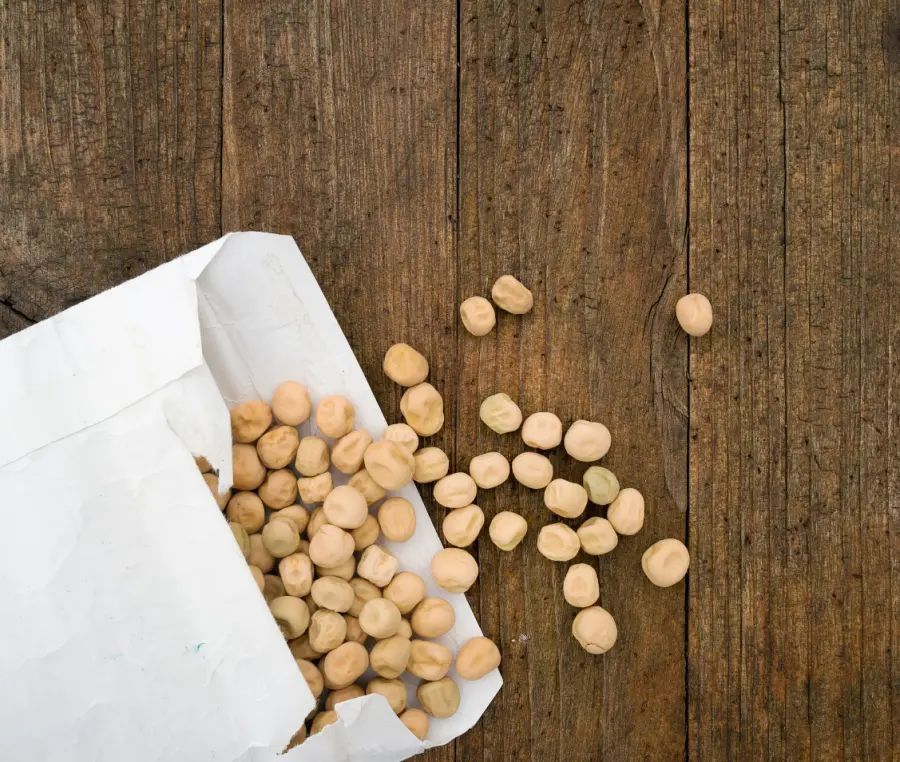
1796 - Bernard McMahon Starts the First Seed Store in Philadelphia
McMahon was a pioneer in the nursery trade of seeds. This Irish-American also opened a botanical garden alongside his seed store in Philadelphia. He is known for publishing American Gardener's Calendar (the first American gardening book) and he was the curator of the seeds collected by Lewis and Clark. A line that stands out in his book is: "Is it because [native plants] are indigenous that we should reject them? What can be more beautiful than our Lobelias, Asclepias, Orchis, and Asters? In Europe plants are not rejected because they are indigenous; and yet here [in America], we cultivate many foreign trifles, and neglect the profusion of beauties so bountifully bestowed upon us by the hand of nature."
Early 1800's - A Shift in American Gardening Styles
Prior to 1800, American gardening tended to be for necessity. Americans grew herbs, medicinal flowers, and vegetables together doorway or walled kitchen gardens. They had larger plots for vegetables such as potatoes, corn, wheat, and carrots. They grew food and medicine, not flowers for show. Of course, there were exceptions among the wealthy and upper class citizens.
After surviving the Revolutionary War and subsequent battles afterward, Americans began to look past growing just food for survivability. And while the War of 1812 certainly slowed down the shift of American gardening, it was full blown by the 1830s.
1820 - Founding of the US Botanical Garden
Although it was not the first, the US Botanical Garden's founding showed that America really was a nation at last. For what seem more enduring than a national collection of plants? It is the oldest public garden in the United States. Congress established the garden and President James Madison signed a bill authorizing the land usage. It was moved to its current location on the National Mall in 1933.
1830 - Invention of the Lawn Mower
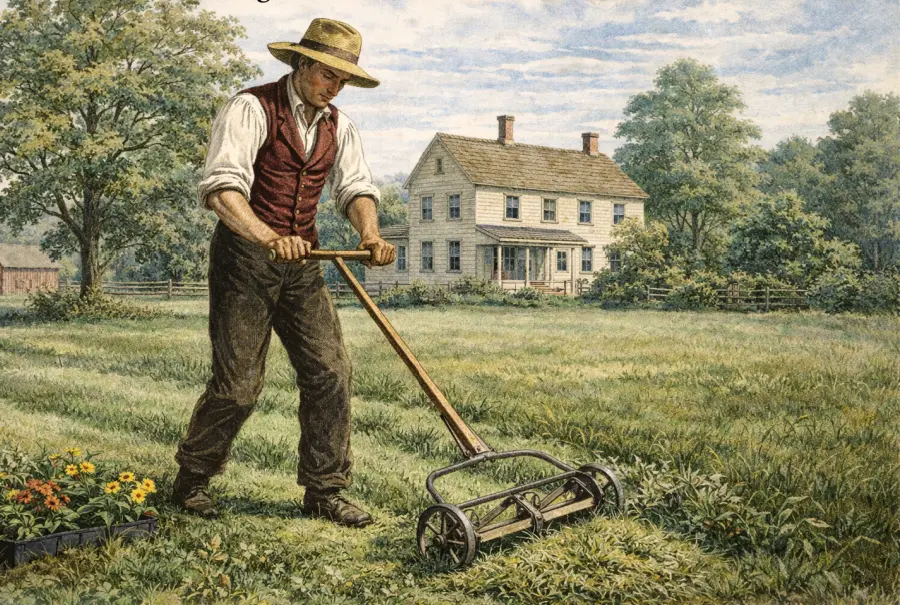
The first lawn mower was invented in 1830 in England. It was used to maintain and cut grass on sports fields and lawns more efficiently than a scythe. Pushed from behind, it used a cylinder of blades to neatly clip the grass, and ushered in a wave of new innovations for turf care.
Afterwards, Americans began to add lawns to their landscapes, showing it was more than just a thing for kings and the wealthy. Lawns became part of the American Dream, being used in a variety of ways from sports fields and for recreation, as well as to showcase urban prosperity.
Late 1800's - Gardening Changes More
As the century went closer to its close, American gardens continued to evolve and expand. Americans began moving away from the farm to the cities, as manufacturing replaced many specialist jobs. Food was beginning to be grown in larger scales, and many smaller farms were bought up for the first time into large operations. Gardening began to be more about enjoyment, beauty, and relaxation than about necessity, food, and medicine.
1872 - Arbor Day Created
Started by J. Sterling Morton, the first Arbor Day was promoted to plant trees in Nebraska for fuel, shelter, and soil protection. On its first day, over 1 million trees were planted. And there were prizes for those who planted the most trees. The homesite of Morton is in Nebraska City, and is surrounded by many different kinds of trees in the Arbor Lodge State Park. I personally have walked much of the park, and marveled at the many beautiful trees therein.
In 1885, Arbor Day became an official State Holiday of Nebraska, and was spread nationwide by 1920. Today, millions of trees are planted annually on Arbor Day, across the world.
1874 - Frederick Law Olmstead Designs the US Capitol Grounds
Considered the father of landscape architecture as a profession in the United Stated, Olmsted is known for designing Central Park in New York City, as well as the US Capitol Grounds.
1876 - Burpee Seed Founded
Of the many, many seed catalogs I get in the mail each year, Burpee stands out among the rest, because it is the oldest. It brought with it a wave of modernizations to horticulture in America, being followed by many more seed companies geared to sell seeds of flower, vegetables, and herbs, and plants to gardeners.
Early 1900's - Another Shift in American Horticulture
With the advent of the world wars, came the Victory Garden. Often called War Gardens, they became a way for the housewife whose husband or sons were fighting, to feel that they were a part of the impending victory. It was to boost morale as well as to reduce pressure on the food supply. American gardeners grew tons of staple food which could be sold or traded at local store. The programs encouraged a large production of potatoes, carrots, onions, beets, cabbage, and more.
1900 - Chestnut Blight Devastate American Chestnut Trees
When American chestnut trees began to die on the east coast, they knew something bad had happened. Chestnut blight, a fungus from Asia, killed hundreds of millions of chestnut trees from the Mississippi River eastward. Now, only a few survivor trees live in regions beyond the river, including in Iowa and Kansas. As a tree, the American chestnut no longer exists east of the river, surviving only as a shrubby mass of stems and leaves, because the disease does not kill the roots.
1905 - Bailey Nursery Founded
Started as a failed vegetable farm, Bailey became one of the largest wholesale nurseries in the US. J.V. Bailey, a University of Minnesota Agriculture School graduate, was the first to use an automobile at the farmer's market to boost sales of his produce, flowers, and trees. Today, Bailey Nursery has over 5,000 acres of production in Minnesota, Oregon, Illinois, and Washington. They may be best known for Endless Summer Hydrangeas, First Editions plants, and many more new cultivars of landscape trees and shrubs.
1919 - Earl May and Gas-Powered Mowers
Two events shaped the early post-WWI gardening scene in America. While gas-powered mowers had already been invented, it took the innovation of Col. Edwin George to transform them into a machine more cost-effective for the everyday America. This made lawns in America even more practical for the people of the middle class. The first self-propelled riding gas-mower came along only 3 years later.
Also in 1919, Earl May in Iowa started his seed and nursery company as a successful mail-order business. It grew quickly with the use of radio station KMA for marketing, opening its first retail garden center in 1932, which then spanned across Iowa, Kansas, Missouri, and Nebraska.
1922 - American Horticulture Society Founded
Even though other American gardening societies exist and many others were founded earlier, I believe this one to be more of the pinnacle of American horticulture. This society is a non-profit whose members are dedicated to fostering a culture of gardening and sustainable American horticulture. Its headquarters are at River Farm in Alexandria, Virginia, a property once owned by George Washington.
1926 - Monrovia Nursery Started
Harry E. Rosedale Sr., a Danish immigrant founded Monrovia Nursery company in Monrovia, CA. It started small but quickly became America's premier wholesale nursery company, celebrating 100 years in 2026. In 1941, Monrovia became the first major US grower to patent a plant. Now Monrovia operates 4 major nurseries in Georgia, California, Connecticut, and Oregon.
1928 - Dutch Elm Disease Hits American Streets
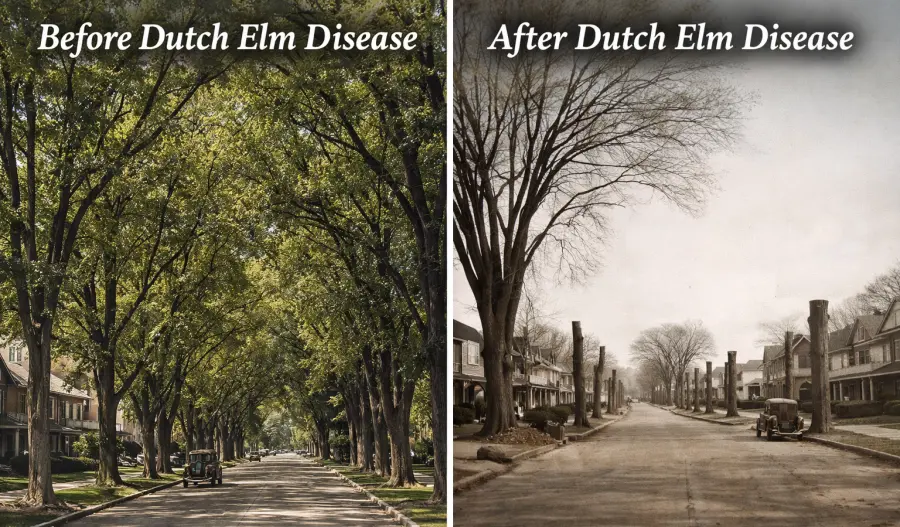
Prior to the Great Depression, before things got bad, came the introduction of Dutch Elm Disease, a fungal disease from Europe which blocks water movement in American elm trees. Millions of trees died seemingly overnight as the disease swept across the American landscape. Just like that, American streets were treeless.
The American elm had been used to line the streets in both commercial and residential locations. Unfortunately, we did not learn about the value of biodiversity in our street trees until the second onslaught, the wave of Emerald Ash Borer in the early 2000s.
Post World War 2
WWII brought its own problems to the American horticulture scene, though many thought opposite. The widespread use of pesticides on farmland in lawns became a popular thing after the war. People thought the use of these pesticide the perfect solution to the "evil" pests of the day. Now, many years later, we are trying to erase the idea that pesticides are "our most valuable tool" in insect and weed control.
1945 - Greenleaf Nursery Company Started
Started as a small cash and carry garden center, Greenleaf Nursery transformed into a national supplier with over 600 acres of production in Oklahoma, Texas, and North Carolina.
1946 - J. Frank Schmidt & Son Company Started
Originally started on 10 acres, this wholesale nursery company has expanded to over 3,000 acres. They are known for popular tree introductions like Red Sunset maple and Redpointe Maple. Our biggest supplier of bareroot trees, we owe a lot of our success to their tree selections.
1947 - Rodale Institute Founded
The Rodale Institute was founded by J.I. Rodale as the Soil and Health Foundation. From Pennsylvania, Rodale committed to research in organic agriculture and was a leader in regenerative organic agriculture. He wrote about the importance of cover cropping, composting, and protecting healthy soil. Until it was turned over to the USDA in 2002, all organic certification was done by the Rodale Institute.
1960 - Plant Hardiness Map Introduced
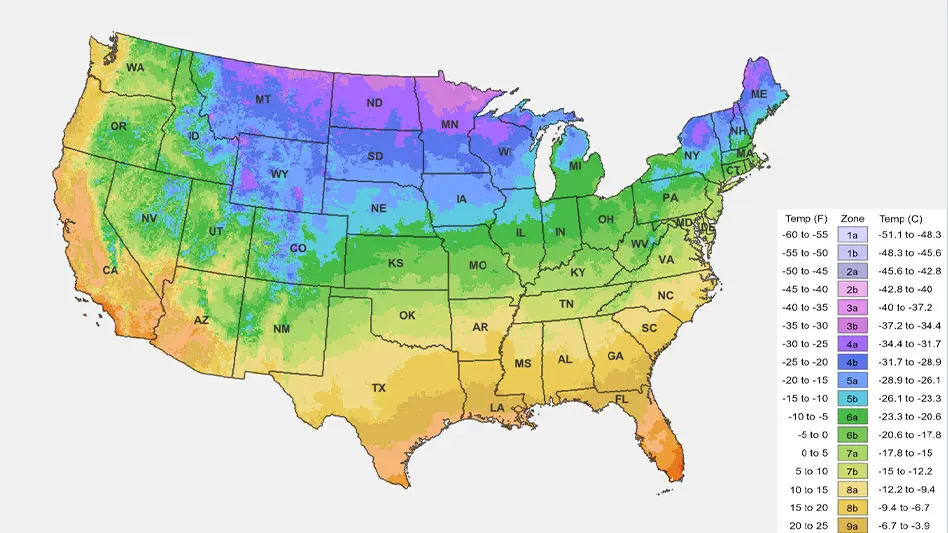
Plant hardiness mapping originally started in 1927 at the Arnold Arboretum, but the first map was issued by the USDA in 1960. These maps are crucial for many shoppers when purchasing plants, both online and in-person for their gardens, as many garden centers carry plants out of their range.
1962 - Silent Spring Released
Rachel Carson's famous articles and then full fledged book exposed the dangers of the pesticides being sprayed wantonly across America's farmlands and lawns. After such exposure, the shift to environmentally safe farming and gardening was born. Even though we still have to deal with the pesticides of the modern era, we at least are aware of what is happening instead of being ignorant about it.
1970 - The First Earth Day
Earth Day was first held on April 22nd, 1970, marking the birth of the environmental movement across first America, and then the rest of the world. It was promoted to raise public awareness of pollution and demand environmental reform. Coming in the wake of Silent Spring, Earth Day had some 20 million Americans joining in, and is credited with the creation of the Clean Air, Clean Water, and Endangered Species Acts, and well as the establishment of the EPA.
1975 - Seed Savers Exchange Started
This non-profit was started to preserve and share heirloom seed. It has become a network of seed saving and sharing gardeners across the world. They even developed a 890 acre heritage farm in Decorah, Iowa, as a major seed bank and conservation center.
1975 - Premier of the Victory Garden on PBS
I grew up watching this show in the 1980s and 1990s and used to rewatch episodes for years. There was so much information on a wide range of topics including vegetables, flowers, lawns, gardens, soil, composting, and cooking.
2000's And Beyond
The year 2000, when all the computers were supposed to go haywire (and did not), also marked a turn towards more home based gardening trends. It started with the resurgence of community gardens, which promoted the growing of vegetables and flowers in communities where usable land was often covered in concrete. Even in college, we used community gardens as exploration ports for finding insects and learning about vegetables.
2002 - Enter Emerald Ash Borer
As I mentioned previously, we were not fully aware of our lack of biodiversity in city and rural landscapes until Emerald Ash Borer popped on the scene. Since 2002, this tiny beetle has killed millions of ash trees across our landscape, and is still making its way across Kansas, Nebraska, and the Great Plains as we speak. It has been a disaster. For American horticulture, it was a wakeup call to diversify the landscape.
2005 Amazon Prime
Even though online shopping has been around since the 1970s, it did not really take off until Amazon Prime was introduced in 2005. Since then, nearly every household in America has ordered something off Amazon, and many of them have ordered plants and gardening equipment.
2014 - Garden Answer
YouTube brought in a new era for gardeners, mainly those that do their learning via videos and the internet. YouTube has helped millions of Americans (including me) in learning about tips and tricks of American horticulture. Garden Answer continues to be the biggest and most popular of these gardening "channels". They drive consumer buying and influence a world of gardeners.
Proven Winners
Considered the leading plant brand worldwide, Proven Winners has become America's premier branding for plants, across a wide range of types. Started in 1992, it has jumped to the lead in the market share only recently, with their white branded containers, and promotional YouTube influencers.
The Next Generation
Who knows where the trends will lead from here. We may have a whole host of new pests and diseases looming on the horizon. Already, spotted lanternfly waits on the east coast, and other pests ravage American woodlands. AI (artificial intelligence) will likely be used more and more, though I have seen that the current generation wants real experiences over computer-generated ideas. We must wait and see what will come down the line. I do see native plants becoming more and more popular, though I saw that coming years ago.
No matter what comes or goes, American horticulture will continue on.
Happy planting!